

Most articles about the common symptoms of a pool leak were written for Florida, California, or some other place with normal weather. Las Vegas pools don't play by those rules.
In the Valley, evaporation can pull a quarter inch of water out of your swimming pool every single summer day. That's normal. So when a homeowner in Summerlin or Henderson tells us their pool is "just losing water to the heat," they're usually half right and half wrong. The heat is real. But the leak underneath it is real too.
This guide walks you through the actual symptoms we see on Las Vegas pools, how to tell a leak from desert evaporation, and when it's time to stop guessing and call a professional.
If these signs point to a real leak, our pool leak detection service explains how we isolate and confirm the source.
Why the Common Symptoms of a Pool Leak Look Different in Las Vegas
We've spent over a decade running leak detection across Clark County. The desert changes how every classic symptom shows up.
A few things specific to Las Vegas pools:
- Evaporation is brutal. A typical Vegas pool can lose between an eighth and a quarter inch a day in summer. That's about two inches a week with no leak at all.
- Caliche soil hides leaks. Most yards in the Valley sit on caliche, a hard, calcium-rich layer that doesn't drain well. Water from a small underground leak can travel sideways for yards before it surfaces, so the wet spot you see may not be near the actual break.
- Calcium and hard water mask cracks. Las Vegas water leaves heavy scale. That scale can fill in a hairline crack so well that a swimming pool stops leaking visibly, then opens up again when the chemistry changes.
- Soil movement around skimmers is the norm. Caliche shifts, decks settle, and skimmer-to-deck joints crack. We see this on 50-year-old plaster pools in East Las Vegas and on five-year-old post-tension builds in Summerlin.
Knowing how local conditions hide and reveal leaks is half of accurate leak detection. The other half is testing.
"Nine times out of ten when a homeowner tells me 'it's just the heat,' we find a leak. Vegas evaporation is aggressive, but a healthy pool shouldn't lose more than a quarter inch a day, even in July." Nick, Southern Nevada Leak Detection
The Bucket Test: How to Rule Out Evaporation First
Before you panic about a pool leak, run a bucket test. It takes five minutes and tells you a lot.
Here's how to do it:
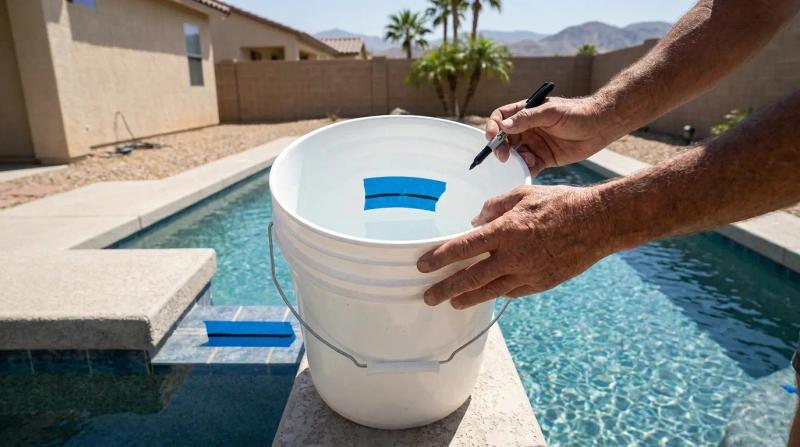
- Fill a bucket about three quarters full of pool water.
- Set the bucket on the second step of your pool so the bucket water sits at the same level as the pool water.
- Mark both water levels with tape or a marker.
- Turn off the autofill if you have one.
- Wait 24 hours. Run the pump like normal.
- Compare the drop in the bucket to the drop in the pool.
If the pool dropped more than the bucket, you have a leak. If they dropped about the same, it's loss due to evaporation. If the swimming pool drops faster only when the pump is on, the leak is on the pressure side. If it drops faster only when the pump is off, the leak is on the suction side.
The bucket test won't tell you where the leak is. It will tell you that you actually have one.
The Most Common Symptoms of a Pool Leak We See in the Valley
These are the symptoms we field calls about most often. Some are obvious. The dangerous ones aren't.
1. Pool water level dropping faster than it should
This is the headline symptom. If you're adding water more than once a week in summer, or your autofill is running constantly, treat it as suspicious. Run the bucket test, then call us if it confirms a leak.
2. Wet spots or soft ground around the pool
Step around the pool barefoot in the morning before the sun cooks the deck. Soft, soggy, or weirdly green grass next to a pool surrounded by dry desert landscaping is a flag for an underground plumbing leak.
3. Cracks in the pool structure
Hairline plaster cracks are usually cosmetic. Cracks in the pool structure, especially ones longer than a foot or that you can fit a credit card into, can leak gallons a day. Vertical cracks in the tile band and step risers are common in Las Vegas because of soil movement.
4. Air bubbles in the return jets
If you see a steady stream of small bubbles coming out of your return when the pump is running, air is being pulled into the suction line. That means there's a leak between the skimmer or main drain and the pump. This one gets missed a lot because people assume it's normal turbulence.
5. A water bill that won't quit
If your SNWA water bill jumped 30 to 100 dollars and your watering schedule didn't change, your pool is a likely suspect. A small underground plumbing leak can quietly waste hundreds of gallons a day.
6. Standing water or corrosion at the equipment pad
Walk the equipment pad. Drips at unions, salt cells, heater connections, or the pump seal are all signs of equipment leaks. If the slab is wet, rusty, or growing mineral deposits, water is escaping somewhere.
7. Skimmer water level that's always low
If the water level always sits below the bottom of your skimmer opening, two things could be going on. Either you have a shell leak draining the pool to that line, or you have a skimmer leak right at the throat. Skimmer leaks are one of the most common swimming pool leaks we repair.
8. Loose tile, separated coping, or sunken deck sections
When a pool has been leaking under the deck for months, the soil washes out underneath. The deck settles, coping pulls away from the bond beam, and tiles pop loose. Don't assume that's just age.
9. Algae and pool chemicals that won't behave
Constantly adding water means constantly diluting your pool chemicals. If you're chasing chlorine and battling algae despite running your system right, a slow leak may be the real reason.
If two or three of these sound like your pool, you very likely have a leak. Call (725) 550-5365 or request a free quote. We cover the whole Las Vegas Valley.
Common Pool Leak Symptoms by Type: Where the Water's Actually Going
Different leaks show different symptoms. This table is the cheat sheet we wish more pool owners had before they called us.
| Leak Type | Common Symptoms | How We Diagnose It |
|---|---|---|
| Shell or structural crack | Visible cracks in the pool, water level stops at the crack line, plaster discoloration | Visual inspection plus dye testing at suspect cracks |
| Skimmer leak | Level always at the skimmer mouth, cracks at the deck-skimmer joint, soft ground next to skimmer | Dye testing the skimmer throat and weir |
| Underground plumbing leak | Wet spots far from the pool, high water bill, water loss only when pump runs, bubbles in returns | Pressure testing each line, then electronic listening gear |
| Light niche leak | Water tracking through conduit to junction box, wet wall behind pool, level drops to light line | Dye test at the niche, conduit inspection |
| Equipment pad leak | Visible drips, rusted slab, pump losing prime, low filter pressure | Visual inspection with system running, plus pressure testing |
| Main drain leak | Water level keeps dropping all the way to the main drain, no other obvious symptoms | Pressure testing the main drain line, dye testing |
If your pool is showing more than one of these symptoms, you may have more than one leak. That's not unusual on older Vegas pools.
Red Flags That Mean Call Today, Not Next Week
Some pool leak symptoms can wait a few days. Some can't. Here's our shortlist for "stop reading and call."
- Water dropping more than an inch a day. That's a major leak losing hundreds of gallons.
- Soft, sinking ground next to the pool. That's actively washing out fill, and it can crack the deck or shift the pool itself.
- Air locking in the pump. A bad suction-side leak can burn out a pump in days.
- Visible cracks growing or weeping water. Structural cracks can fail fast.
- Equipment pad water reaching electrical components. Pool electrical and standing water are a real safety risk.
Letting any of these go costs you more in repairs than calling early. Catching leaks early is the cheapest fix you'll ever make on your swimming pool.
What To Do When You Suspect a Leak in Your Pool
If your pool is losing water and you've ruled out evaporation, here's the play.
Step 1: Document the loss. Mark the water level. Track how much it drops in 24 hours. Note whether the loss happens with the pump on, the pump off, or both.
Step 2: Walk the perimeter. Look for wet spots, soft soil, deck cracks, loose tile, and equipment pad drips. Take photos.
Step 3: Check the equipment pad. Look for drips at every union, valve, pump seal, filter clamp, and heater inlet. Listen for hissing.
Step 4: Call a professional leak detection service. Don't pay a landscaper or general handyman to dig up your deck on a guess. A real pool leak detection company tests, isolates, and locates the source of the leak before any concrete is touched.
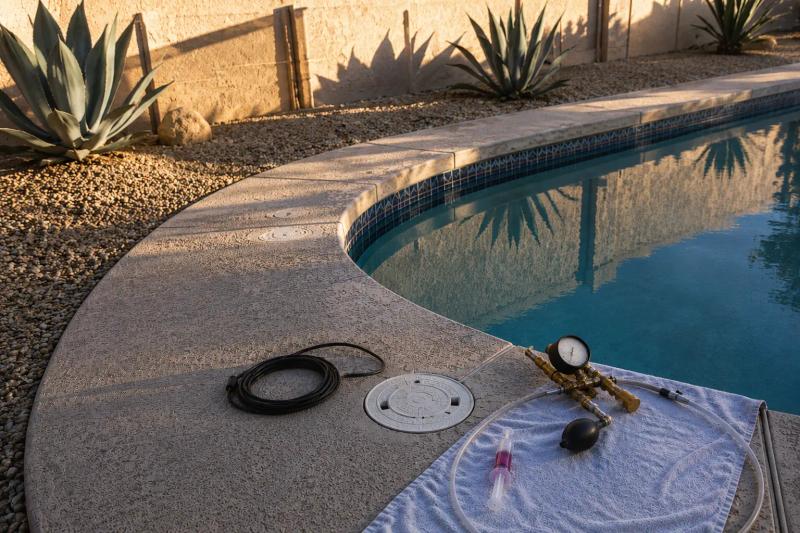
We use pressure testing rigs, hydrophones, dye testing, and electronic leak detection gear. We test until we know exactly where the water is going. Then we fix the leak, usually on the same visit.
How to Prevent Pool Leaks in the Future
Most pool leaks in the Valley come from three things: soil movement under the deck, scale and chemistry damage to plaster, and worn-out plumbing fittings. You can stay ahead of all three.
- Keep your chemistry balanced. Aggressive water eats plaster and grout. So does over-chlorinated water. Test weekly in summer.
- Watch your deck and skimmer joints. Caulk separations early before water gets behind the bond beam.
- Don't ignore small drips at the equipment pad. A slow drip becomes a flood when the pump cycles on for the thousandth time.
- Get a pool leak inspection any time you notice an unexplained water bill spike. Catching a small leak early is a fraction of the cost of repairing the damage a long-running leak causes.
Why Las Vegas Pool Owners Call Southern Nevada Leak Detection
Most leak detection companies hand you a report and walk away. We don't. We're an owner-operated team (Nick and Kevin) with over a decade of experience finding and fixing pool leaks across the Las Vegas Valley.
When you call, you get an owner. When we show up, you get an owner. We do both pool leak detection and pool leak repair under one roof, including:
- Pool crack repair, including Torque Lock structural staples
- Pool skimmer leak repair
- Underground plumbing leak detection with minimal excavation
- Pool equipment leak repair at the pad
- Pool light leak repair at the niche
- Spa leak detection and repair
We serve the entire Las Vegas Valley, including Las Vegas, Summerlin, Henderson, Green Valley, Spring Valley, Enterprise, North Las Vegas, Paradise, Boulder City, Lake Las Vegas, and Kyle Canyon.
Stop Guessing. Find the Leak.
If your pool is losing water and you've spotted any of the symptoms above, the longer you wait, the more it costs. Call us and get answers fast.
Call (725) 550-5365 or request a free quote online. Same-week scheduling. Owner on every job. One company, one invoice, one accountable team.
.jpg)