

When a homeowner searches "detection of leakage" online, they're usually past the bucket test stage. They know their pool is losing water. What they want now is the technical answer: what does a real pool leak specialist actually do, and what tests do they run?
Most articles still respond with a generic checklist. This one doesn't.
We've spent over a decade running pool leak detection across the Las Vegas Valley. (If you want the leak found and fixed rather than a how-to, our pool leak detection in Las Vegas service page covers pricing, timing, and what to expect.) Below is the actual diagnostic sequence we use on Vegas pools, why each step matters, and where the average DIY attempt or general-handyman approach falls apart.
What Detection of Leakage Actually Means for a Pool Owner
In the field, "detection of leakage" is not a single test. It's a layered process. The job is to answer four questions in this order:
- Is the pool actually leaking, or just losing water to evaporation?
- Is the leak in the shell, the plumbing, or the equipment?
- Exactly where is the leak located?
- How do we fix it without tearing up the entire deck?
That last question is the one most "leak detection" companies skip. They hand you a vague report and a quote from somebody else. We do detection AND repair as one job, same crew, same visit when possible.
"Detection of leakage isn't one tool. It's a process of elimination. We don't stop testing until the answer is the only one that fits." Nick, Southern Nevada Leak Detection
If you're still trying to confirm whether you have a leak at all, start with our guide on the common symptoms of a pool leak. If you already know you have one, keep reading.
The Order a Las Vegas Specialist Runs for Detection of Leakage
Here's the actual sequence we run, in order, on a typical leak call in Henderson, Summerlin, or anywhere across Clark County.
Step 1: Confirm the water loss.
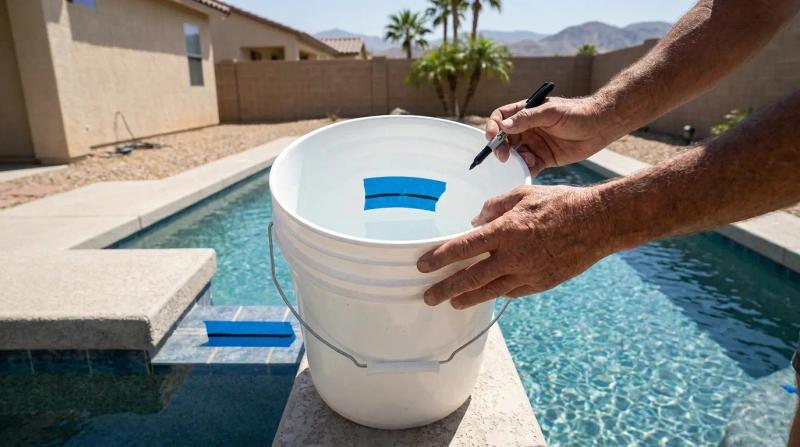
We mark the water level, turn off the autofill, and watch how much the pool drops over a set window. We do it twice: once with the pump running, once with it off. If the loss is bigger when the pump runs, the leak is on the pressure side. If the loss is bigger when the pump is off, it's on the suction side or the shell.
Step 2: Inspect the equipment pad.
Most leak calls have at least one obvious drip somewhere on the pad. Unions, valves, pump seals, salt cells, heater inlets, and filter clamps fail constantly in Vegas heat. We catch those before we even touch the buried plumbing.
Step 3: Pressure test each plumbing line.
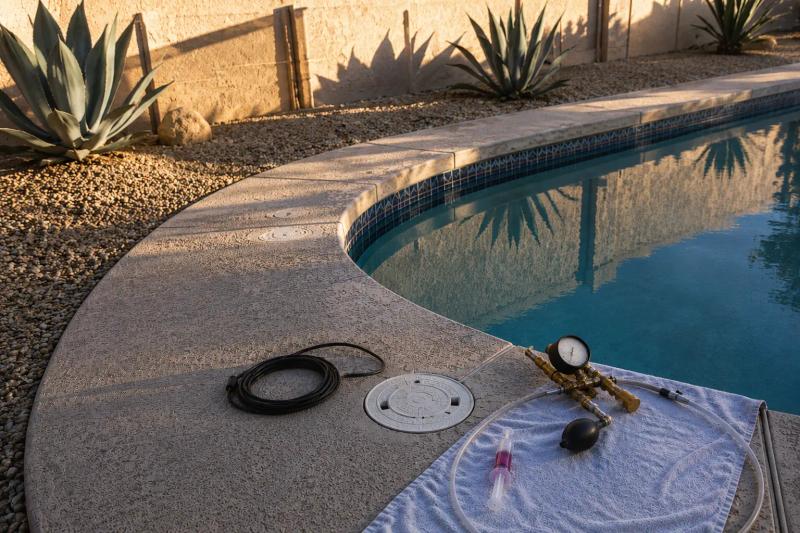
We isolate each line one at a time (skimmer line, return lines, main drain) and pressure-test them with a calibrated rig. A line that won't hold pressure has a leak. The pressure drop pattern tells us roughly where to focus.
Step 4: Dye test the pool shell.
In a still pool, we use a colored dye at suspect points: cracks, tile bands, light niches, the skimmer throat, the main drain, and return fittings. The dye gets pulled toward any opening. We watch closely with a mask on.
Step 5: Electronic listening for buried lines.
For underground plumbing leaks, we use hydrophones (in-water listening devices) and ground microphones to triangulate the sound of pressurized water escaping. With practice, we can pinpoint a buried leak to within a foot or two.
Step 6: Conduit and niche inspection.
Pool light niche leaks are sneaky. The water often travels through the wiring conduit and surfaces somewhere far from the pool. We dye-test the niche and check the conduit when needed.
Step 7: Document and repair.
We mark the location, photograph it, and walk you through the fix before any concrete or tile is touched. Most repairs happen the same day.
If your pool is losing water and you're tired of guessing, call (725) 550-5365 or request a free quote. Same-week scheduling across the Las Vegas Valley.
Methods of Detection of Leakage: Which Test Catches What
Different methods catch different leaks. This table is the cheat sheet most homeowners never see.
| Method | What It Detects | When We Use It |
|---|---|---|
| Static water level test | Confirms a leak exists, separates pump-on vs pump-off loss | Always first, before any other testing |
| Equipment pad visual | Drips at unions, valves, pump seals, gaskets, heater connections | Every job, takes minutes, catches obvious leaks first |
| Pressure testing | Plumbing leaks in specific lines (return, suction, main drain) | When loss tracks the pump, or when no shell leak is visible |
| Dye testing | Shell cracks, skimmer leaks, light niche leaks, main drain leaks | Whenever the loss happens with the pump off, or visible suspects exist |
| Electronic / hydrophone listening | Buried plumbing leaks, including under decks and slabs | After pressure testing flags a line, to pinpoint the break |
| Camera / scope inspection | Conduit failures, drain line breaks, separated fittings | When pressure or listening tests need visual confirmation |
| Isolation testing | Which of multiple lines is the actual source of the leak | When more than one leak is suspected on the same pool |
If a "leak detection" company shows up and only runs one or two of these methods, they're going to miss something. Real swimming pool leak detection uses whichever combination the symptoms call for.
Common Leak Sources and What They Tell Us
Once we've narrowed the location, the type of leak tells us how serious it is and how to repair it.
- Cracked plumbing under the deck. Common on pools 15+ years old. Caliche soil shifts, PVC fittings fail at the glue joints. Repair usually means a small, targeted excavation, not a full deck tear-up.
- Skimmer leaks. Among the most common pool leaks we find. Skimmer throats crack at the deck joint when soil moves. Fast fix when diagnosed correctly.
- Light niche leaks. Water tracks through the conduit. We see this most on older pools where the niche grommet has dried out.
- Equipment pad leaks. Almost always a worn fitting, gasket, or pump seal. Quick fix when caught early.
- Shell cracks. Hairline cracks are usually cosmetic. Structural cracks in the bond beam or floor are serious. We use Torque Lock structural staples on the cracks that need them.
- Main drain leaks. Water level keeps dropping all the way to the main drain line. Often missed because there are no other obvious symptoms on the deck.
Why DIY Leak Detection Falls Short on Las Vegas Pools
Las Vegas adds problems generic leak detection guides don't account for.
Caliche soil hides the leak path. Water from a buried pipe leak can travel sideways for yards through compacted caliche before it surfaces. The soggy spot you see may be ten feet from the actual break. DIY guesses tend to dig in the wrong place.
Calcium scale fakes a pressure test. Heavy scale inside Vegas plumbing can partially block a line and make a small leak look like a passing test. Without the right rig and the right pressure, you can miss the leak entirely.
Heat and evaporation muddy the data. A pool can lose two inches a week in July with no leak at all. Without a properly run bucket test, homeowners chase ghosts or ignore real leaks.
Multiple leaks are common. Older Vegas pools often have two or three small leaks at once. DIY testing usually finds the obvious one and stops. We test until every line and surface is accounted for.
Skip the guesswork. Call (725) 550-5365 for accurate detection of leakage on the first visit.
When to Call for Professional Detection of Leakage
Some pool leak situations can wait a few days. Some can't. Call today if you see any of these.
- Water dropping more than an inch a day
- Soft, sinking ground near the pool, deck, or equipment pad
- Air locking in the pump (pump losing prime, low filter pressure)
- Visible cracks in the pool that are growing or weeping water
- Standing water near pool electrical components
- A water bill that doubled with no change in usage
These all point to active water loss that gets worse fast. Catching them early is cheaper than the structural and electrical damage they cause if ignored.
Why Las Vegas Pool Owners Choose Southern Nevada Leak Detection
We're an owner-operated team (Nick and Kevin) with over a decade of experience finding and fixing pool leaks across the Las Vegas Valley. When you call, you get an owner. When we show up, you get an owner.
We do the entire job under one roof:
- Pool leak detection in Las Vegas using pressure, dye, and electronic methods
- Pool leak repair on the same visit when possible
- Underground plumbing leak detection with minimal excavation
- Pool skimmer leak repair
- Pool light leak repair
- Pool equipment leak repair
- Pool crack repair including Torque Lock structural staples
- Spa leak detection and spa leak repair
We serve the entire Las Vegas Valley including Las Vegas, Summerlin, Henderson, Green Valley, Spring Valley, Enterprise, North Las Vegas, Paradise, Boulder City, Lake Las Vegas, and Kyle Canyon.
Stop Guessing. Find the Leak.
If your pool is losing water and you want answers from someone who actually knows the Vegas Valley, call us.
Call (725) 550-5365 or request a free quote online. Same-week scheduling. Owner on every job. One company, one invoice, one accountable team.
.jpg)