

If your pool is losing water and you've called around for quotes, you've heard the same two phrases over and over: pressure testing and dye testing. Most companies use both. Few explain why.
Here's the short version. Pressure and dye testing for pool leaks are the two tools that turn "your swimming pool is leaking somewhere" into "your pool is leaking right here, and this is what we'll do about it." One tells us which line is bad. The other tells us exactly where the water is escaping. Used together, they catch leaks that either method alone would miss.
We've spent over a decade running pool leak detection across the Las Vegas Valley. Below is how we actually use these two methods, why Vegas pools require a different read on each test, and what a pool owner can realistically do without specialized tools.
If these tests point to a real leak, our professional pool leak detection in Las Vegas page explains how we isolate and confirm the source.
What Pressure and Dye Testing for Pool Leaks Actually Are
Both tests answer the same question (where is the water going?) from two different angles.
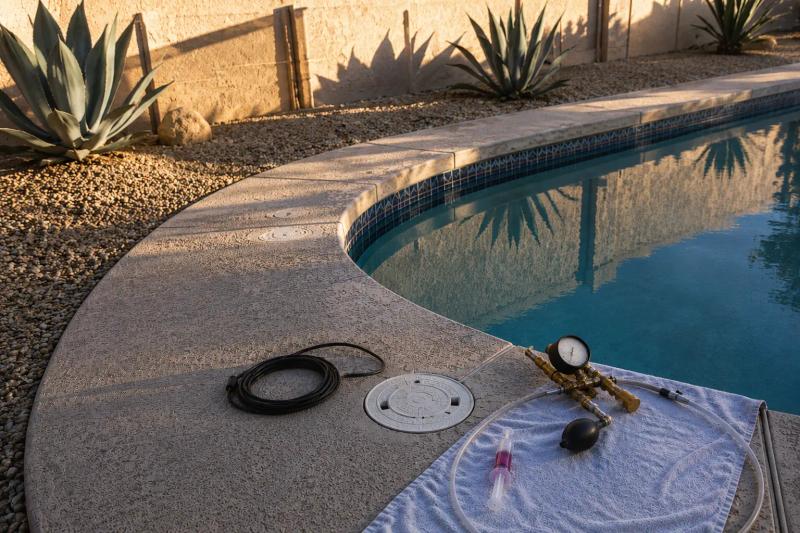
Pressure testing seals off a section of plumbing and pressurizes it. If pressure holds, the line is intact. If it drops, there's a leak somewhere in that line. Pressure testing tells us which pipe or fitting is bad without ever touching the pool shell.
Dye testing uses a colored pool dye applied close to a suspected leak point. Any opening in the shell or fitting creates a small inward current as water escapes. The dye gets drawn in, and you watch it disappear into the crack. Dye testing pinpoints leaks the eye can't see.
Pressure tests work for buried, hidden, or pressurized plumbing. Dye tests work for visible surfaces and slow drains. They cover different worlds.
"Most leaks need both. Pressure tells me the line. Dye tells me the spot. If you only use one, you're either guessing where to dig, or you're missing leaks behind the tile." Nick, Southern Nevada Leak Detection
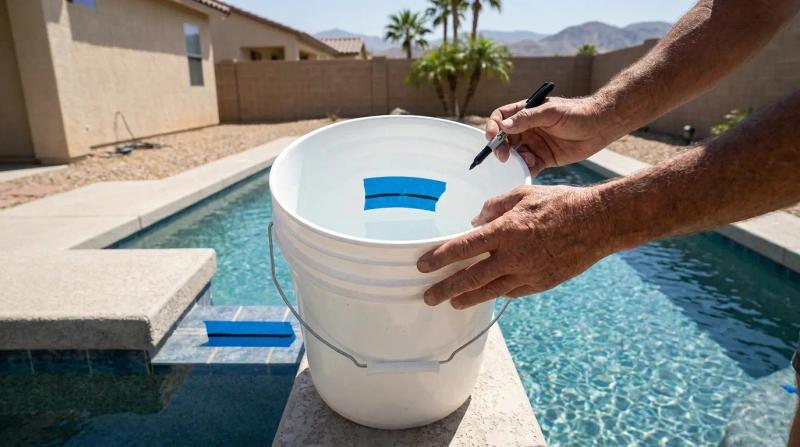
If you haven't confirmed your pool is actually leaking yet, run a bucket test first. We walk through it in our guide on the common symptoms of a pool leak.
How We Use Pressure Testing on Pool Plumbing
Pressure testing is the workhorse for any buried or hidden line. Here's the process.
Step 1: Isolate the line. We plug both ends of the line being tested (return line, skimmer line, main drain, or each return individually). Most pools have at least three or four separate lines that need to be tested one at a time.
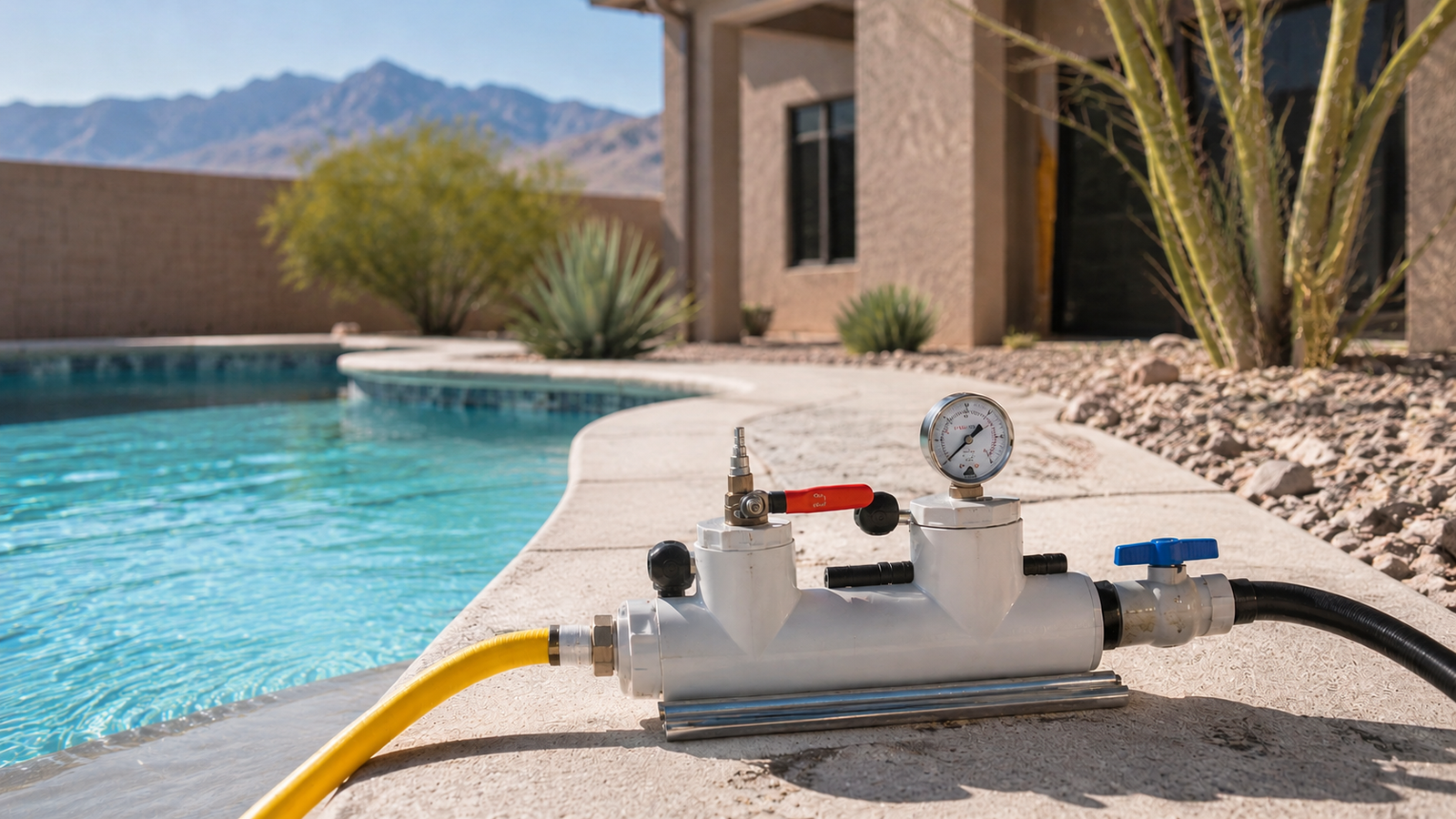
Step 2: Pressurize. We attach a pressure rig and bring the line up to around 15 to 25 psi using air or water. Pool-grade plumbing should hold that pressure indefinitely.
Step 3: Watch the gauge. A line that holds pressure passes. A line that drops fast has a major leak. A line that drops slowly over 10 to 20 minutes has a small leak.
Step 4: Locate the break. Once a line fails, we move to electronic listening with a hydrophone or ground microphone to triangulate the actual break location. A failed pressure test only tells us "this line." Listening gear tells us "this specific spot, within a foot."
A few things worth knowing:
- Pressure testing can be run with air or water. Air is faster and lets us listen for hissing at fittings. Water is closer to real-world conditions but messier.
- Anyone using a homemade rig with a bicycle pump and a tire gauge is doing it wrong. Without a calibrated gauge and proper plugs, the test isn't reliable, and you can damage the plumbing.
- Multiple leaks on the same pool are common in older Las Vegas builds. Every line gets tested, not just the suspect one.
How We Use Dye Testing on the Pool Shell
Dye testing is the precision tool. The setup is simple. The skill is in the read.
Equipment: A syringe-style dye tester (the Anderson Manufacturing dye tester is the industry standard), pool-grade phenol red or similar dye, a mask and snorkel, and a calm pool.
Step-by-step process:
- Turn off the pump and let the water go completely still. Wind and current ruin a dye test.
- Get in the pool with a mask. Position the syringe within a half inch of the suspected leak point.
- Slowly release a small amount of dye near suspected areas: visible cracks, the skimmer throat, light niches, return jets, the main drain, tile grout lines.
- Watch for the dye to be drawn in. A leak creates a clear inward flow that pulls the dye into the opening like a thread.
- If the dye sits in place, that spot isn't leaking. Move to the next suspect.
What dye testing finds:
- Hairline cracks invisible from the deck
- Skimmer leaks at the throat or weir
- Light niche leaks at the gasket or conduit
- Failed return fittings
- Leaks at the main drain pot
- Separated grout or tile seams
- Vinyl pool liner seam failures (rare in Vegas, common in other regions)
What dye testing can't do: it can't find buried plumbing leaks. The water is escaping below the pool, not into the pool. That's pressure-test territory.
Why Pressure and Dye Testing for Pool Leaks Work Better Together
A pool leak job that uses only one of these tools misses leaks. Here's why we run both, in sequence.
| Test | What It Finds | When It Shines | Limits |
|---|---|---|---|
| Pressure testing | Plumbing leaks in buried or hidden lines | Loss happens with the pump running, or no shell leak is visible | Only tests plumbing, not the pool shell |
| Dye testing | Shell cracks, skimmer leaks, niche leaks, fitting failures | Loss happens with the pump off, or visible suspects exist | Doesn't find buried plumbing breaks |
| Combined | Nearly any leak source on a residential pool | Almost every real leak call we run | Requires specialized tools and a trained eye |
Our realistic field sequence:
- Bucket test to confirm a leak exists.
- Visual walk of shell, deck, and equipment pad.
- Dye test the obvious shell suspects first (skimmer, niches, visible cracks). Fast, no rig needed, often finds the leak in 15 minutes.
- If shell dye tests come back clean, pressure test the plumbing. This usually flags a line.
- Electronic listening on the flagged line to pinpoint the buried break.
- Final dye check on the located area to confirm.
- Repair.
We catch a large share of leaks at step 3, more at step 5, and the rest with combined testing on tricky cases. Skipping any step is how leaks get missed.
Want to skip the guesswork? Call (725) 550-5365 or request a free quote. Same-week scheduling across Las Vegas, Henderson, Summerlin, and the rest of Clark County.
The Las Vegas Twist: What Local Conditions Change
Generic leak-testing guides assume mild weather and average soil. Las Vegas is neither.
Calcium scale can fake a pass. Vegas water leaves heavy scale inside plumbing. A line with a slow leak can show up as a pass on a quick pressure test because mineral buildup partially seals the crack. We hold the test longer, sometimes at slightly higher pressure, to expose these.
Hot decks cause dye drift. In summer, the water near the pool surface heats up faster than the water deeper down. That creates tiny convection currents. Dye can drift on those currents and look like it's being pulled into a leak when it isn't. We test in the morning or at dusk when we can, or shade the test area first.
Scale can mask a crack during dye testing. Heavy calcium buildup can fill a hairline crack so tight that no current pulls the dye in, even though the crack opens up again when chemistry shifts. We test the same crack twice, sometimes days apart, if the symptoms don't match the result.
Caliche soil hides what pressure testing can't. Even after pressure testing flags a line, the actual leak point under the deck can be hard to find because water travels sideways through compacted caliche. Hydrophone work has to be more methodical here than in softer-soil regions.
Older Vegas pools may have galvanized steel transitions. Plumbing from the 50s and 60s sometimes still hides under decks in central Las Vegas. Corrosion at these transitions can fake test results.
DIY Pressure and Dye Testing for Pool Leaks: What's Realistic and What's Not
We get this question a lot. Here's the honest answer.
What you can DIY:
- The bucket test. Easy, free, tells you whether you have a leak at all.
- A basic dye test using a consumer leak detection dye kit or, in a pinch, food coloring. It won't be as precise as a pool-grade syringe-style dye tester, but you can sometimes find an obvious skimmer crack or a leaking light niche in calm water.
- Visual inspection of the equipment pad. Drips at unions or pump seals are usually visible. Mineral buildup, rust, and corrosion around fittings are valuable clues.
What you can't realistically DIY:
- Pressure testing pool plumbing. The rig, plugs, and gauges are specialized tools that cost more than hiring a pro for a single visit. Improvised setups can damage your plumbing system.
- Electronic listening for buried lines. Hydrophones and ground mics take practice to read.
- Repair without diagnosis. Pool putty or epoxy on a guess wastes time and money.
The honest math: hiring a pool leak detection and repair specialist for one visit usually costs less than buying the equipment to do one test yourself, and the diagnosis is far more reliable. Catching leaks early is preventive maintenance. Letting them run for months is how you get costly repairs to the deck, the bond beam, and the equipment pad.
When to Skip DIY and Call a Pro
Call us today if you see any of these.
- A significant drop in water level (more than an inch a day)
- Soft, sinking ground next to the pool or under the deck
- Bubbles coming steadily from return jets when the pump runs
- Pump losing prime or struggling to hold pressure
- Visible cracks growing or pulling apart
- Standing water near pool electrical components
- Water bills that doubled with no change in usage
- Algae and chlorine problems that don't respond to normal pool maintenance
These all point to active, unexplained water loss that gets worse fast. Catching them early safeguards the deck, the structure, and the equipment pad.
Why Las Vegas Pool Owners Choose Southern Nevada Leak Detection
We're an owner-operated team (Nick and Kevin) with over a decade of experience finding and fixing pool leaks across the Las Vegas Valley. When you call, you get an owner. When we show up, you get an owner.
We do the entire job under one roof:
- Pool leak detection using pressure, dye, and electronic methods
- Pool leak repair on the same visit when possible
- Underground plumbing leak detection with minimal excavation
- Pool skimmer leak repair
- Pool light leak repair
- Pool equipment leak repair
- Pool crack repair including Torque Lock structural staples for long-lasting fixes
- Spa leak detection and spa leak repair
We serve the entire Las Vegas Valley including Las Vegas, Summerlin, Henderson, Green Valley, Spring Valley, Enterprise, North Las Vegas, Paradise, Boulder City, Lake Las Vegas, and Kyle Canyon.
For more on how all of these methods fit into a full leak detection job, read our breakdown on the detection of leakage process.
Stop Guessing. Find the Leak.
If your in-ground pool is losing water and you want answers from someone who actually knows the Vegas Valley, call us.
Call (725) 550-5365 or request a free quote online. Same-week scheduling. Owner on every job. One company, one invoice, one accountable team.
.jpg)