

This is the number one question we get every summer: "Is my pool leaking, or is it just the heat?"
It's a fair question, and in Las Vegas it's a genuinely hard one. The pool leak vs evaporation problem is tougher here than almost anywhere in the country, because the desert pulls water out of a pool faster than just about any climate in America. A pool can lose real gallons every day with no leak at all.
So before you panic (or before you ignore a real problem), let's settle it. Here's how to tell normal pool water evaporation from a leak, the bucket test that proves it, and the gray-area cases most pool owners get wrong.
If the bucket test points to a real leak, schedule a pool leak detection visit so we can isolate and confirm the source.
Why Pool Leak vs Evaporation Is So Hard to Call in Las Vegas
Evaporation is a natural process. Water molecules at the surface absorb heat and escape into the air. The hotter and drier the air, the faster the rate of evaporation.
Las Vegas checks every box that speeds it up:
- Extreme heat. Summer air temperature regularly tops 105 degrees. Warm water evaporates faster.
- Bone-dry air. Low humidity is the single biggest driver. The drier the air, the faster water evaporates from a pool. Vegas is one of the driest metros in the country.
- Constant sun. Direct sun raises pool water temperature, which speeds evaporation even more.
- Wind. A breeze across the surface carries off moisture and accelerates the whole process.
Put those together and a Las Vegas pool can lose about a quarter inch of water per day in peak summer. That's normal. The same pool in a humid climate might lose a fraction of that.
This is exactly why so many real leaks get written off as "just evaporation" here. The heat gives a leak the perfect cover story.
"In Vegas, evaporation is the best excuse a leak ever had. Homeowners blame the heat for months while a cracked skimmer quietly drains gallons a day. The heat is real, but it shouldn't cost you more than a quarter inch." Nick, Southern Nevada Leak Detection
How Much Pool Water Evaporation Is Normal in Las Vegas?
Here's a rough baseline we give homeowners across the Valley.
- Summer (June to September): Around a quarter inch a day is typical. On a hot, windy, low-humidity day it can briefly run higher.
- Spring and fall: Usually an eighth to a quarter inch a day.
- Winter: Much less, often a sixteenth to an eighth of an inch a day.
To put that in perspective, a quarter inch a day on an average backyard pool adds up to dozens of gallons of water lost to the air every single day. Multiply that across a week and the drop looks alarming even when nothing is wrong.
The key number to remember: more than a quarter inch a day in summer, or any fast loss in winter, is suspicious. That's the line where we stop blaming the heat and start testing.
The Bucket Test: How to Settle Leak or Evaporation in 24 Hours
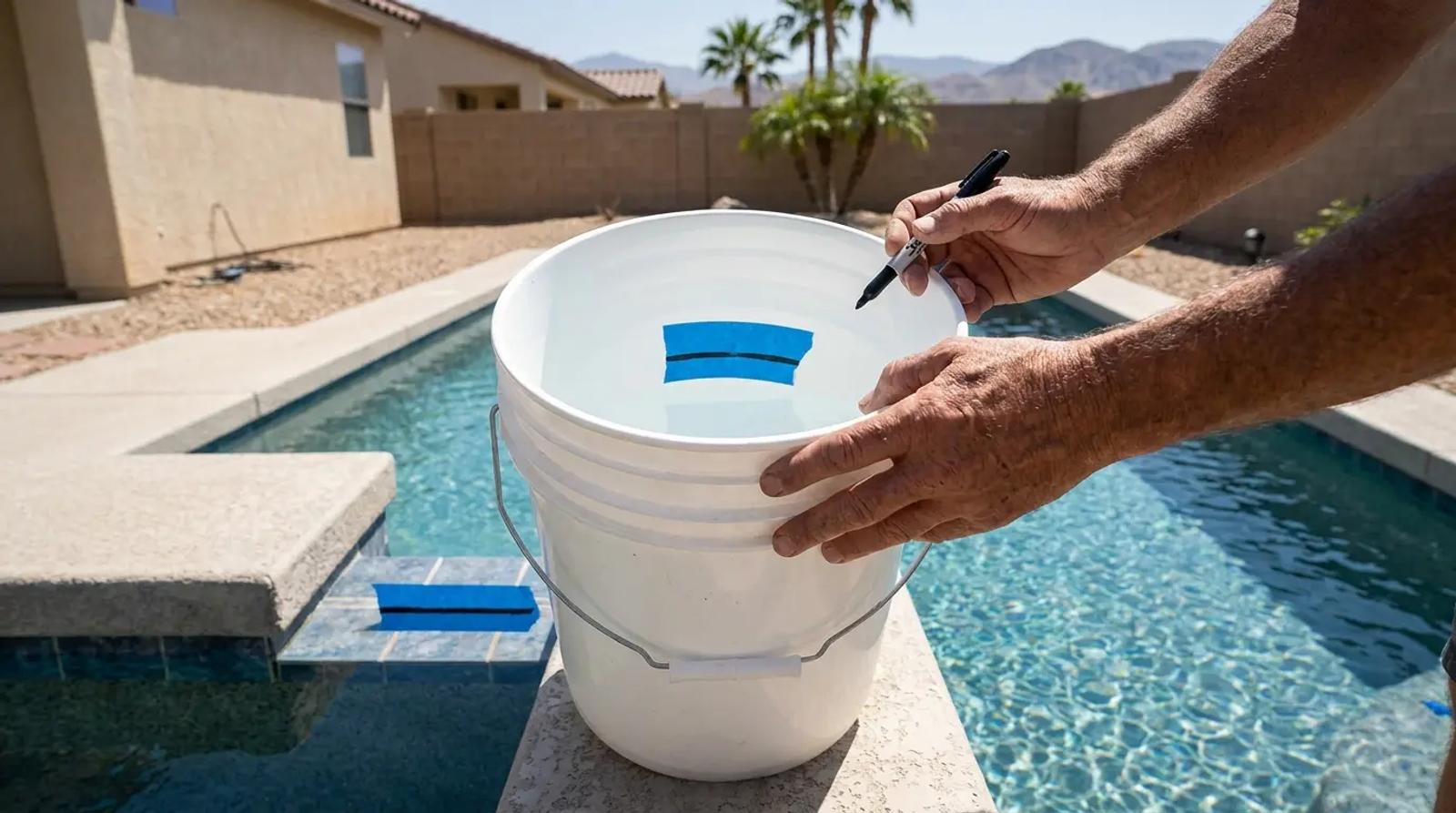
The bucket test is the simplest, cheapest way to answer the question. It works because the water in the bucket and the water in the pool sit in the same air, same sun, same heat. They evaporate at the same rate. So if the pool drops faster than the bucket, the extra loss is a leak.
Here's the step-by-step.
- Fill the bucket with pool water about three-quarters full.
- Place the bucket on a step, usually the second step, so the water level inside the bucket lines up with the pool water level outside it.
- Mark the water level in two spots: the water line inside the bucket, and the pool water level on the outside of the bucket. Use tape or a grease pencil.
- Turn off the autofill if your pool has one.
- Wait 24 hours. Run the pump on its normal schedule.
- Compare the two marks. If the level on the inside of the bucket and the pool dropped about the same, it's evaporation. If the pool dropped more than the water level inside the bucket, you have a leak.
Want to go a step further? Run the test twice. Once with the pump running, once with it off. If the pool loses more water with the pump on, the leak is on the pressure side. If it loses more with the pump off, the leak is on the suction side or in the shell. That's a valuable clue we use to start our diagnosis.
Pool Leak vs Evaporation: Reading Your Results
The bucket test is the headline, but it's not the only signal. Here's how the full picture sorts out.
| What You See | Points to Evaporation | Points to a Leak |
|---|---|---|
| Water loss rate | About a quarter inch a day or less in summer | More than a quarter inch a day, or fast loss in winter |
| Bucket test | Pool and bucket drop the same amount | Pool drops more than the water inside the bucket |
| Ground around the pool | Dry, same as the rest of the yard | Soggy spots or green grass in dry desert landscaping |
| Pump on vs pump off | Loss is the same either way | Loss changes depending on whether the pump runs |
| Water bill | Gradual seasonal rise in summer | Sudden spike with no change in usage |
| Time of year | Worst in peak summer heat | Happens year-round, even in winter |
| Equipment pad | Dry and clean | Drips, puddles, rust, or mineral corrosion |
If two or three rows on the right side describe your pool, you very likely have a leak. Call (725) 550-5365 or request a free quote. We cover the whole Las Vegas Valley.
The Gray Area Most Pool Owners Miss
Here's the part the generic articles skip: it's often both.
A Las Vegas pool can have completely normal evaporation AND a slow leak at the same time. The evaporation hides the leak. The homeowner sees a big water drop in July, shrugs, and blames the heat. Meanwhile a cracked skimmer or a bad return fitting is adding a little more loss on top every day.
This is the most common mistake we see. People treat the question as either/or. The real question isn't "leak or evaporation." It's "how much of this loss is more than evaporation can explain?"
That's why the bucket test matters so much. It strips the evaporation out of the equation and shows you only the extra loss. If there's extra loss, there's a leak, no matter how hot it is outside.
What Makes a Pool Evaporate Faster (and How to Slow It Down)
If your bucket test comes back clean and it really is just evaporation, you can still cut your water loss. The biggest factors:
- Water features. Fountains, spillways, and waterfalls are evaporation machines. Moving water and extra surface area mean a pool with a running fountain can lose far more water than a still one. Shut features off when you're not enjoying them.
- Water temperature. A heated pool or spa evaporates faster. Drop the temperature a few degrees in summer.
- Wind exposure. A windbreak, fence, or landscaping on the windward side slows surface evaporation.
- No cover. A pool cover is the single most effective fix. A good cover can cut evaporation dramatically by trapping the moisture and blocking sun and wind.
These steps reduce evaporation, lower your water bill, and make it easier to spot a real leak the next time your level drops.
When the Numbers Point to a Leak
Some results mean it's time to stop testing and call. Reach out today if you see any of these.
- Pool losing more than an inch of water a day
- The pool drops noticeably more than the bucket in 24 hours
- Soft, sinking, or soggy ground next to the pool or under the deck
- Water loss that continues through winter
- A water bill that doubled with no change in usage
- Drips, puddles, or corrosion at the equipment pad
- Cracks in the pool structure that are growing or weeping water
These all point to active water loss a leak can cause. The longer a leak runs, the more it costs in structural and equipment damage. Catching it early is the cheapest fix you'll ever make.
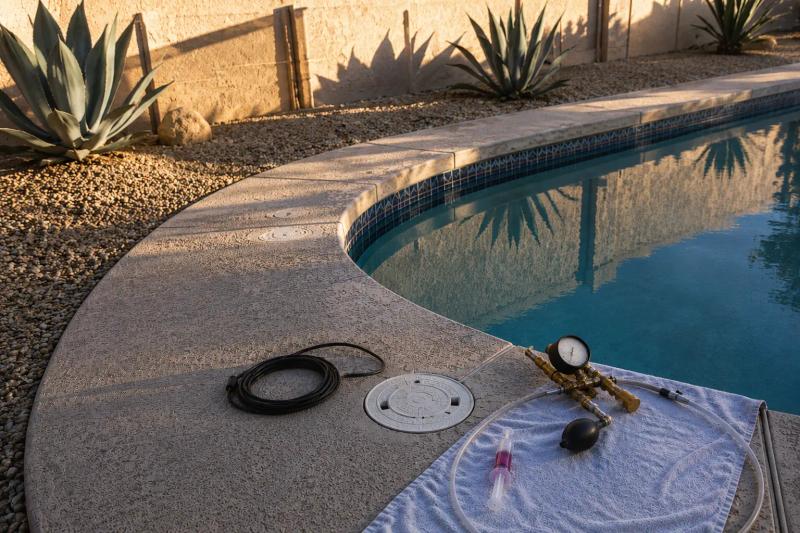
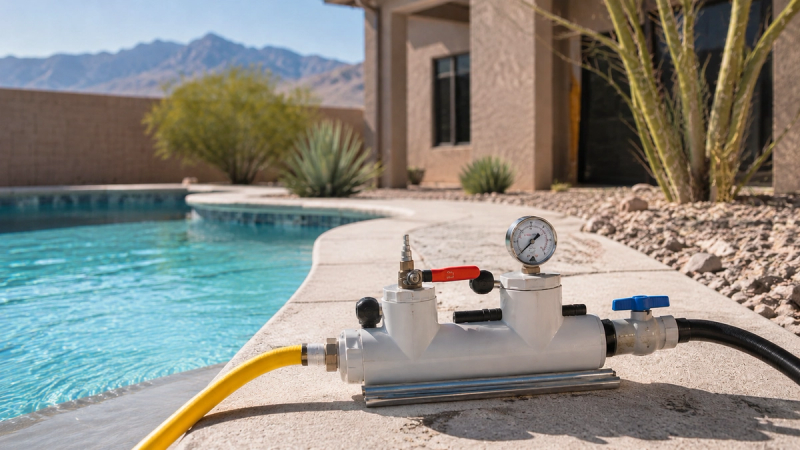
When the signs point to a leak, we run a full diagnosis: pressure testing the plumbing, dye testing the shell, and electronic listening for buried lines. You can read exactly how that works in our guide on pressure and dye testing for pool leaks.
Why Las Vegas Pool Owners Choose Southern Nevada Leak Detection
We're an owner-operated team (Nick and Kevin) with over a decade of experience finding and fixing pool leaks across the Las Vegas Valley. When you call, you get an owner. When we show up, you get an owner.
We do the entire job under one roof:
- Pool leak detection using pressure, dye, and electronic methods
- Pool leak repair on the same visit when possible
- Underground plumbing leak detection with minimal excavation
- Pool skimmer leak repair
- Pool light leak repair
- Pool equipment leak repair
- Pool crack repair including Torque Lock structural staples
- Spa leak detection and spa leak repair
We serve the entire Las Vegas Valley including Las Vegas, Summerlin, Henderson, Green Valley, Spring Valley, Enterprise, North Las Vegas, Paradise, Boulder City, Lake Las Vegas, and Kyle Canyon.
New to the signs of a leak? Start with our guide on the common symptoms of a pool leak.
Stop Guessing. Find the Leak.
If your pool is losing water and the bucket test points to a leak, don't let the Vegas heat take the blame. Call us and get a real answer.
Call (725) 550-5365 or request a free quote online. Same-week scheduling. Owner on every job. One company, one invoice, one accountable team.
.jpg)